
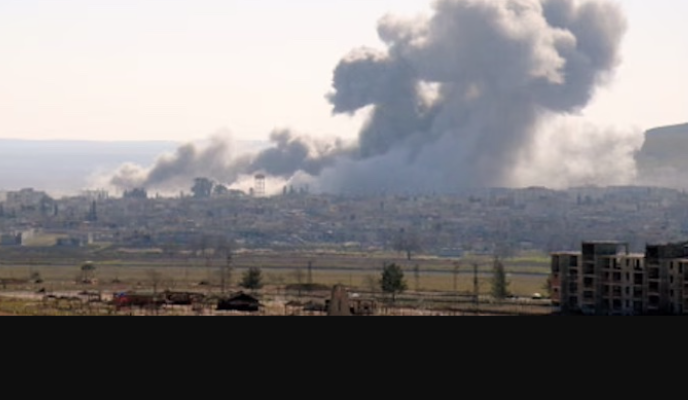
The United States military, in coordination with partner forces, has carried out extensive airstrikes against Islamic State (IS) positions in Syria, following a deadly attack on American personnel late last year.
US Central Command (Centcom) confirmed that the operation was conducted on Saturday in response to a December 13 ambush near Palmyra, where two US soldiers and a civilian interpreter were killed by IS fighters.
The strikes were authorised by President Donald Trump as part of Washington’s broader counterterrorism efforts and its commitment to protecting US and allied forces in the region.
According to Centcom, more than 90 precision-guided munitions were deployed against over 35 Islamic State targets, with more than 20 aircraft involved in the operation. Assets used included F-15E Strike Eagles, A-10 Thunderbolt II attack aircraft, AC-130J gunships, MQ-9 Reaper drones, and Jordanian F-16 fighter jets.
“Our message remains clear and resolute: if you harm our warfighters, we will find you and kill you anywhere in the world,” Centcom said in a statement.
US officials did not disclose the specific locations targeted or provide details on casualties resulting from the strikes.
US Defence Secretary Pete Hegseth described the operation as a continuation of America’s response to the December attack, stressing that the action was defensive rather than an escalation into a broader conflict. “This is not the beginning of a war.
It is a declaration of vengeance,” Hegseth said, adding that the United States would act decisively to defend its personnel wherever they are deployed.
Centcom also revealed that in the weeks leading up to the latest operation, US and partner forces had killed or captured nearly 25 Islamic State members during multiple missions carried out between December 20 and December 29.
Syria remains politically fragile following the fall of former President Bashar al-Assad in December 2024, which brought an end to the country’s 13-year civil war.
Despite being significantly weakened, the Islamic State continues to operate in parts of the country, particularly in areas of the northeast, where it has targeted Kurdish-led forces and their allies.