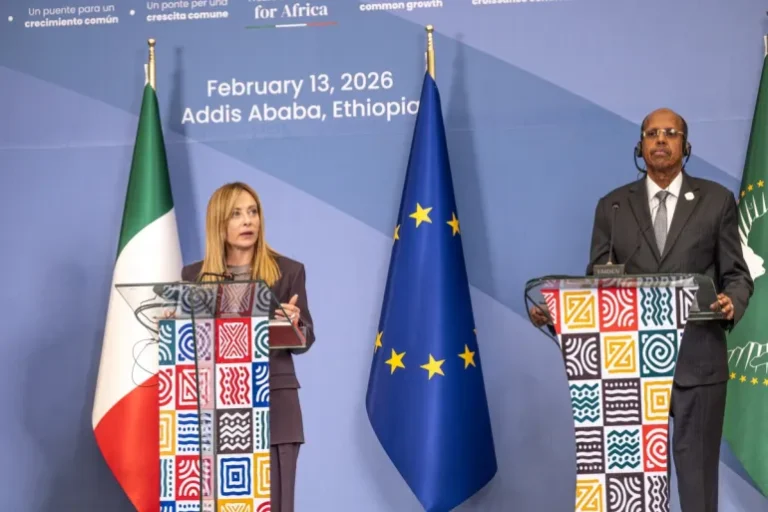
Leaders of the African Union (AU) have called for an end to what they described as the “extermination” of Palestinians, as heads of state and government convened in Addis Ababa for the bloc’s 39th Ordinary Summit.
Chairperson of the African Union Commission, Mahmoud Ali Youssouf, said the suffering of Palestinians “challenges our consciences,” urging an immediate halt to the violence and calling for adherence to international humanitarian law.
Youssouf’s remarks come amid continued hostilities in the Israel-Gaza conflict, despite a declared ceasefire. He stressed that international law must remain the foundation of global engagement and reiterated the AU’s longstanding support for Palestinian self-determination.
Beyond the Middle East, the AU chairperson highlighted ongoing conflicts across Africa, calling for renewed commitment to the union’s “Silencing the Guns” initiative. He cited instability in Sudan, the Sahel, eastern Democratic Republic of Congo, and Somalia as areas of urgent concern.
“From Sudan to the Sahel, to eastern DRC and Somalia, our people continue to pay the heavy price of instability,” Youssouf said, underscoring the need for coordinated continental action to restore peace and security.
The two-day summit has drawn representatives from the AU’s 55 member states, with deliberations expected to focus on armed conflicts, governance challenges, democratic backsliding, and climate-related threats.
Addressing the gathering, United Nations Secretary-General Antonio Guterres described the AU as a “flagship for multilateralism” at a time of global division. He renewed calls for reform of the UN Security Council, describing the absence of a permanent African seat as “indefensible.”

“This is 2026, not 1946. Africa must be at the table when decisions about the African world are made,” Guterres said.
This year’s summit theme centres on water and sanitation, reflecting growing concerns over water security across the continent.
Ethiopian Prime Minister Abiy Ahmed emphasised the strategic importance of water management for development and stability, noting that responsible stewardship is essential to sustainable growth.
Water-related challenges remain a source of interstate and communal tensions in parts of Africa, including disputes over shared resources, farmer-herder conflicts, and climate-driven disasters such as floods and droughts.
The summit also provides an opportunity for African leaders to reassess partnerships with global powers amid shifting geopolitical dynamics and reductions in international aid.