

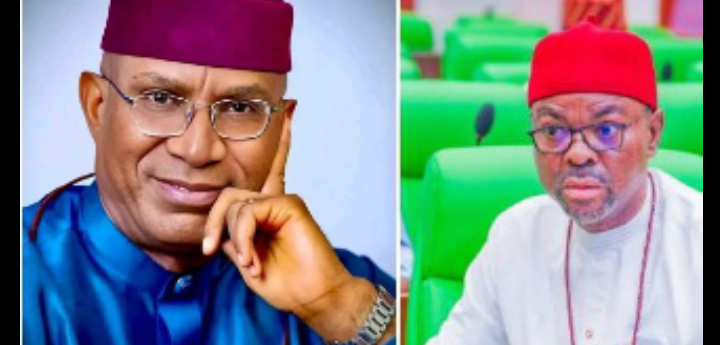
There’s no polite way to say this: if politics in Ndokwa/Ukwuani is to be taken seriously, then performance must replace rhetoric. What Ovie Omo-Agege has demonstrated through clearly documented constituency projects is the minimum benchmark for modern political accountability, not an exception to be admired from afar.
Across Delta Central, his interventions follow a pattern that is difficult to ignore: targeted infrastructure (500KVA transformers in Ekakpamre, Imodje-Orogun, and Kokori Inland), education-focused ICT investments, and practical social amenities such as solar-powered water schemes, Federal Polytechnic Orogun, University of Medical and Health Sciences Kwale, to mention but a few. These are not abstract promises; they are verifiable assets embedded in communities. The political strategy is equally deliberate; campaigning with a scorecard, not slogans.
By contrast, Ndokwa/Ukwuani political office holders have largely failed to institutionalize this culture of measurable delivery. Campaign cycles in these areas are still dominated by vague assurances, ceremonial project flag-offs, and minimal follow-through. The result is a widening credibility gap between elected officials and constituents who increasingly demand tangible outcomes. Constituents who demand accountability and scorecard from a political office holder should not be treated with animosity.
This is not merely a partisan critique; it is a governance issue. Constituency representation, particularly at the federal and state levels, is structured around resource allocation for localised development. When these resources do not translate into visible projects like schools, electrification, water systems, ICT hubs among others, it signals inefficiency, weak advocacy, and outright neglect.
Take education as a case study. The ICT centres facilitated in Ovwian, Ewu, and Orhomuru-Orogun are not just buildings; they are capacity-building platforms aligned with digital literacy and JAMB-based examination requirements. An Ndokwa son represented Delta North Senatorial Destrict for over a decade with a less.
Similarly, basic utilities like electricity and water remain inconsistent across many Ndokwa communities. Yet, an Ndokwa son was accused of mobilising his boys to restrict a serving senator access to the under utilised Independent Power Project hosted by Okpai community that could have solved problems of power supplies. Till date, the member representing Ndokwa/Ukwuani Federal Constituencies, Rt. Hon. Nnamdi Ezechi is still struggling to find his place at the House.
The issue, therefore, is less about feasibility and more about political will and execution discipline. Ndokwa/Ukwuani leaders must recalibrate. The era of identity-based politics without performance metrics is fading. Voters are more informed, more connected, and increasingly less tolerant of underperformance. Campaigns going forward should be anchored on audited scorecards, project lists, budget linkages, completion status not anecdotal claims.
To be clear, this is not about elevating one politician above others; it is about establishing a replicable governance model. Deliverables must be tracked, communicated, and defended in the public space. Anything less is a disservice to constituents.
If Ndokwa/Ukwuani political office holders intend to remain relevant, free from criticisms which they perceive as insults and abusive, they must adopt a results-driven framework. Show the projects. Quantify the impact. Defend the record. That is the standard and anything short of it will continue to invite scrutiny, criticism, and ultimately, electoral consequences.