


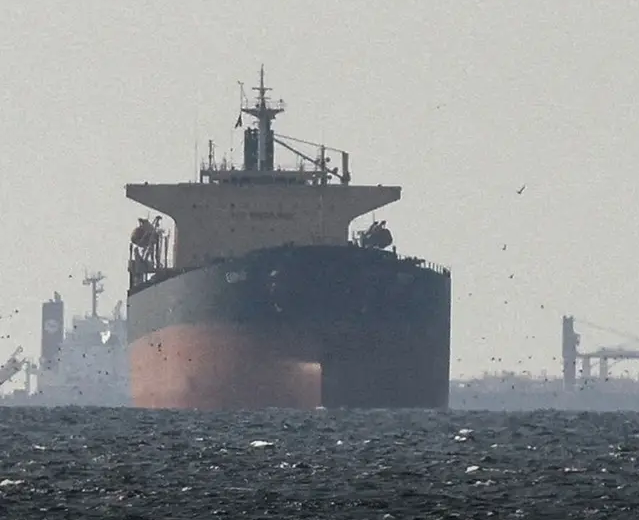
The United States has launched a fresh wave of airstrikes against Iranian military targets after Iranian forces attacked a commercial vessel in the Strait of Hormuz, further escalating tensions between the two countries.
The latest US military action came after Iran’s Islamic Revolutionary Guard Corps (IRGC) announced the closure of the strategic Strait of Hormuz “until further notice” following an incident involving a Cyprus-flagged cargo vessel, the MV GFS Galaxy.
Iranian authorities said the ship ignored repeated instructions and was stopped after warning shots were fired.
In response, the US Central Command (CENTCOM) said Iran had unlawfully attacked a commercial vessel navigating the international waterway.
According to the US military, the ship sustained significant damage to its engine room, forcing the crew to abandon the vessel. One crew member was reported missing.
CENTCOM said American forces struck about 140 Iranian military targets, including missile and drone installations, coastal surveillance sites, communication facilities and military infrastructure along Iran’s southern coastline.
US Secretary of Defense Pete Hegseth defended the operation, saying Iran had “made a poor choice” by targeting international shipping.
Iran acknowledged the strikes, confirming that several coastal military bases and telecommunications facilities were hit. Tehran responded by launching missile and drone attacks against US military installations and allied facilities across the Middle East.
The IRGC claimed responsibility for strikes on the Prince Hassan Air Base in Jordan, alleging that it destroyed the facility’s command centre and drone infrastructure. Iran also said US bases and allied positions in the United Arab Emirates, Qatar, Kuwait and Bahrain were targeted during the retaliatory operation.

The confrontation follows attacks earlier in the week on three commercial oil tankers, which triggered an exchange of military strikes between Washington and Tehran. Iranian officials said previous US attacks killed 17 people and injured more than 100 others.
Meanwhile, diplomatic tensions remain high despite reports that indirect negotiations between both countries are continuing through international mediators.
Iran’s parliamentary speaker, Mohammad Bagher Ghalibaf, declared that the era of “one-sided deals” was over, insisting that Tehran would no longer accept what it described as unequal agreements.
The latest escalation comes days after the burial of Iran’s late Supreme Leader, Ali Khamenei, who was killed during the recent US-Israel conflict. His successor, Ayatollah Mojtaba Khamenei, vowed that Iran would avenge those killed in the conflict, describing retaliation as “the will of the nation.”
The closure of the Strait of Hormuz, through which a significant share of the world’s oil supply passes, has heightened concerns over global energy security and the risk of wider regional conflict.
International observers have warned that continued hostilities could further disrupt global shipping and increase volatility in energy markets.