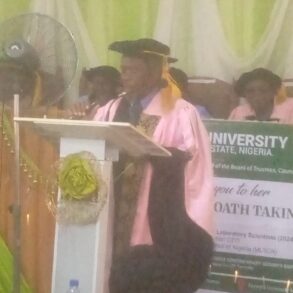
The maiden matriculation ceremony of the University of Medical and Health Sciences, Kwale, held on April 1, 2026, ought to have been a defining moment of pride, unity, and forward-looking commitment for the Ndokwa nation. It was not merely an academic ritual; it was a historic milestone signaling the arrival of a long-awaited institution capable of transforming the educational and economic trajectory of the region. Yet, the conspicuous absence of key Ndokwa political leaders cast a long and troubling shadow over what should have been an unalloyed celebration.
Among those notably absent were the Deputy Governor of Delta State, Monday Onyeme; the Chairman of the Delta State House Committee on Education and member representing Ndokwa West, Charles Emetulu; the member representing Ndokwa East, Emeka Osamuta; and the member representing Ukwuani, Chukwudi Dafe. Also absent were the three local government chairmen: Obi Goddey Nzete, Vincent Osilonya, and Solomon Ajede.
Their absence raises legitimate concerns about priorities, political will, and the depth of commitment to grassroots development. This was not a peripheral event. It was the first matriculation of an institution that holds immense promise for the people they represent. Their nonattendance, therefore, cannot be dismissed as routine scheduling conflicts; it reflects a deeper malaise in the political culture of the Ndokwa leadership class.
It is even more disconcerting when placed in proper context. These same political figures played no visible or decisive role in the establishment of the University of Medical and Health Sciences. That singular credit has been widely attributed to Ovie Omo-Agege, whose intervention and political leverage were instrumental in bringing the institution to fruition. The contrast is stark: those who did not build the institution also failed to show up to celebrate it. The harsh reality is not far-fetched. The same politicians left no legacy, denied the University the needed support will still hijack the employment and other opportunities emerging from the school.
Furthermore, historical precedent compounds the disappointment. During the groundbreaking ceremony of the university, Ndokwa political leaders similarly failed to demonstrate collective ownership by their absence. One might have expected that such an early misstep would be corrected at the matriculation stage; a moment symbolizing the institution’s transition from concept to reality. Instead, the pattern has persisted, reinforcing perceptions of detachment and indifference.
This recurring absence invites a critical question: why do Ndokwa politicians continue to trivialize matters of collective progress through what can only be described as “baby politics”? Developmental milestones should transcend factional alignments, personal rivalries, and narrow political calculations. When leaders reduce such landmark events to arenas of silent protest or passive disengagement, the ultimate losers are the people they are elected to serve.
Leadership, particularly in emerging regions, demands visibility, symbolic participation, and moral encouragement. The presence of political officeholders at such ceremonies is not merely ceremonial; it signals endorsement, fosters confidence among stakeholders, and inspires the younger generation. Their absence, conversely, communicates apathy and sends a damaging message to students, faculty, and prospective investors.
There is also a strategic dimension to consider. Institutions like the University of Medical and Health Sciences require sustained political support for infrastructure expansion, funding, accreditation, and partnerships. By distancing themselves at critical moments, these leaders risk weakening the very institution that could serve as a cornerstone for regional development.
Constructively, this moment should serve as a turning point. Ndokwa political leaders must recalibrate their approach to collective assets and shared achievements. The university is not the project of any single individual; it is a legacy institution for present and future generations. Political actors must rise above parochial tendencies and demonstrate a unified front in nurturing it.
Accountability, however, remains essential. Constituents are justified in demanding explanations for this absence. Public office comes with the responsibility of public presence, especially at events of such magnitude. Silence or vague justifications will only deepen public skepticism.
Ultimately, the issue goes beyond attendance at a single event. It speaks to a broader need for maturity in political engagement within the Ndokwa polity. Development cannot thrive in an environment where leaders selectively participate based on convenience or political calculus. It requires consistency, sincerity, and a shared vision.
The maiden matriculation ceremony should have been a rallying point; a moment to reaffirm commitment to education, youth empowerment, and regional advancement. Instead, it has exposed a leadership gap that must be urgently addressed.
Ndokwa deserves better. Its people deserve leaders who understand that progress is not a partisan trophy but a collective responsibility. Until that mindset takes root, opportunities like the University of Medical and Health Sciences risk being underleveraged, not because of lack of potential, but because of lack of cohesive leadership.