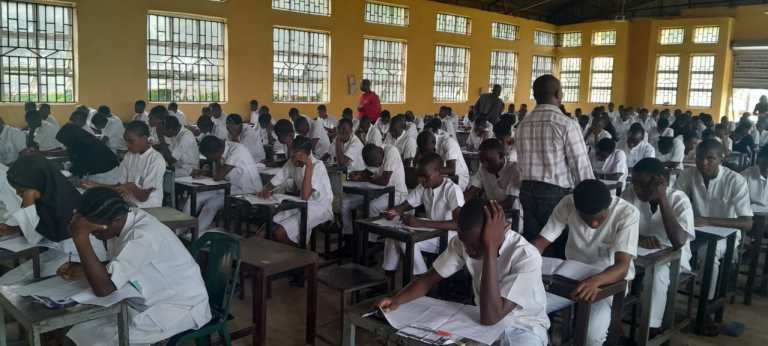
The West African Examinations Council (WAEC) has raised concerns over allegations of the existence of “miracle centres” in Benue State, while advocating the strict adoption of Computer-Based Testing (CBT) to curb examination malpractice.
A WAEC official in Makurdi, Mr Timothy Manga, disclosed this in an interview with the News Agency of Nigeria (NAN), while speaking on concerns over examination malpractice and its impact on the credibility of public examinations and educational certificates.
Manga said allegations about the existence of “miracle” examination centres in the state were worrisome, although WAEC had not officially confirmed any school as operating such a centre.
He described examination malpractice as a threat to the education system, stressing that schools should be known for quality teaching and academic excellence rather than their ability to facilitate cheating during examinations.
He said there was a need for an examination system in which success was determined by knowledge, preparation and competence, rather than candidates’ ability to obtain unauthorised assistance.
According to him, WAEC would continue to monitor developments and investigate credible information relating to schools allegedly facilitating examination malpractice.
Also speaking, a teacher with NKST Secondary School, Makurdi, Mrs Rebecca Ezekiel, called for the establishment of independent examination centres to reduce the influence of schools and teachers over external examinations conducted by WAEC and the National Examinations Council (NECO).
Ezekiel said CBT would give examination bodies greater control over examination venues, personnel and security arrangements.
She also recommended the deployment of biometric verification systems, Closed-Circuit Television (CCTV) cameras and other technologies to strengthen examination monitoring.
“Candidates should be examined under conditions that are independent of the schools where they receive instructions,” she said.
However, a school proprietor in Otukpo Local Government Area, Mr Jude Odeh, cautioned against labelling schools as “miracle centres” simply because they admit students in their final year of secondary education.

Odeh said he had heard allegations about the existence of such centres in Benue but had yet to identify any specific school operating as a “miracle centre.”
He explained that some parents transfer their children to other schools for reasons including the high cost of examination registration and school fees.
According to him, some schools charge examination fees arbitrarily, and when combined with school fees and other charges, the total cost could become unaffordable for some parents.
Odeh, however, said he knew some schools in Benue that did not admit new students into Senior Secondary School Three (SS3), insisting that only students promoted from SS2 were registered for external examinations.
The stakeholders’ positions come amid continuing efforts to strengthen examination security, combat malpractice and protect the credibility of academic certificates issued by examination bodies.
The adoption of CBT, alongside biometric verification, CCTV surveillance and independent examination centres, is being proposed as part of broader measures to ensure that candidates are assessed strictly on their knowledge, preparation and competence.